

Get Ready for Southampton
Highlights
Over 18000 applicants and students took part in Get Ready for Southampton, our custom pre-arrival online course which ran from 2011 until 2019.
Get Ready for Southampton was our highly-successful course preparing international students for living and studying at the University of Southampton in the UK. This self-paced, self-access online course was offered FREE from 2011-2019 to all international students preparing to study at the University of Southampton before their arrival in the UK. The course was run between March and October each year, with a semester 2 entry course running from November to January from 2016 until 2019. It was open to any international student wanted the experience (see below). On the course students could:
- learn about Southampton, a typical university city
- find out about everyday life at university
- find out about the academic culture of a British university and what to expect when they begin their studies
- make contact and communicate with other international students coming to study at the university
International students could find answers to many questions about life and study in Southampton. The resources were interactive and activity-based with multimedia content. They included podcasts, videos and useful links as well as activities to help students learn more.
Student comments about Get Ready for Southampton:
- It is a very useful course. I learned a lot from it.
- I found it very useful and reassuring and [it] gives me self confidence and sense of ease.
- In my opinion, Get Ready for Southampton is very useful and the University should continue to provide this service to its future students. It was interesting, informative and easy to use. Thank you!
- It has been really a good experience taking such an online course before coming to study in UK. I feel myself more prepared for living and studying in UK thanks to this course.
- It is a really helpful effort made by the University of Southampton to make newcomers feel welcome and guide them in the tough beginning where everything is supposed to be done in short time.
- I found it very helpful, I met coursemates there, prepared my mind for it. I think Get Ready for Southampton is what has prevented me from having culture shock.
- Overall, I loved the course. It was a truly unique experience in the sense that Southampton is the only university that has such a programme (at least out of all the universities that I've contacted). Great job (:
- Communication with the University of Southampton has been "outstanding!" I knew what to expect and when to expect it way before I arrive, it was therefore easy for me to plan my trip accordingly. Well done, I am very happy to be here!
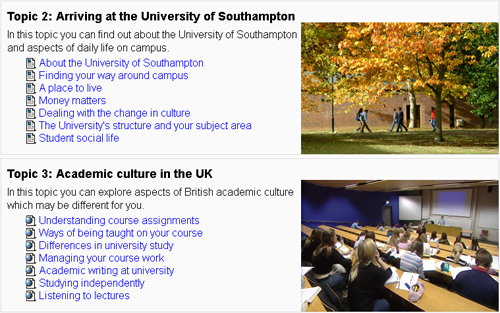
Part of the Get Ready for Southampton course
Growing a MOOC
Get Ready for Southampton (GRfS) began life as Arrive UK, a tutored, pre-arrival online course, which was offered to all international students joining our Pre-sessional Course in EAP between 2005 and 2010. This online course was redesigned into GRfS, a course that could be offered to a much larger number of students and include any international student coming, or even thinking about coming, to the University of Southampton. The course grew in size starting from 2011 (1600+ students); to 2012 (2100+ students); and in 2016 reached over 2400 students! At the end of 2016 we also piloted a version of the course for Semester 2 student entry, which was accessed by 100 students, increasing to over 150 in 2017-18. Over 18000 students used the course up to the final offering in January 2019.
If you are an educator and would like to read more about the design of the course, please see:
Watson, J. (2013). Combining international student social and academic transition online. International Student Experience Journal, Volume 1(2), Autumn 2013. pp.31-36. Available online at https://issuu.com/chrislima90/docs/vol_1_2__full
Here is a sample activity from Get Ready for Southampton:
Arrive UK
Between 2005 and 2010, we ran Arrive UK, a free, tutored, pre-arrival online course, which was offered to all international students joining our Pre-sessional Course in EAP. Building on the wide success of this course, Get Ready for Southampton was designed and developed as a course that could be offered to a much larger number of students and include any international student or visitor coming to the University of Southampton.
Student comments about Arrive UK:
- It is really fantastic as a first-time-used online course!
- It was great experience for me to do this online course. I received lots of benefits of talking online and sharing ideas and information.
- The exercises and materials are very interesting and helpful. I got much information about life in Southampton from these.
- Arrive UK is excellent and I did get some information about my School.