4. Communication: Working with others
Details
Requirement: Working with others
Statements should describe the way in which your work involves collaboration, for example through participation in a team or acting as an interface to other groups.
Relevant evidence would include reflection on collaborations with others, reports outlining your activity within a team process, how you have brokered support for a particular initiative (for example from a technical or legal support service) or how you have worked with others to solve problems.
Description and reflection
I work as the learning technologist within a small production team based in Modern Languages and Linguistics. We have a variety of different development processes which utilise the different skill sets within the team, and share a workspace on a networked drive.
One of these processes is the integrated approach that we take to the process of developing a new learning object. This collaboration involves all three of the full-time members of the team. Firstly, the teacher-developer in the team creates an outline of the activities, consulting with the rest of the team (including myself) to decide on certain elements such as task types. Secondly, the content is transferred from the template into the bespoke tool I have developed, and then passed on to the editor for a first check. Once these initial checks are completed, the learning object is passed to me for any interactive enhancement. This may take the form of an audiovisual recording, or it may involve adaptation of the content to include more advanced, HTML5-based activity types, such as drag-and-drop or matching activities. During this I also proofread the content. The learning object is then passed back to the rest of the team for checking, and then I create a final version. Depending on the course, I may then zip and upload the learning object to the appropriate platform.
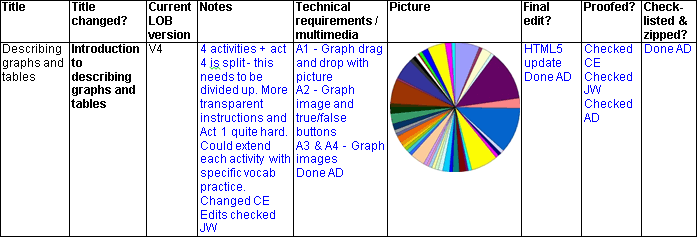
Throughout this process, a progress sheet is kept and used by the whole team to keep track of progress of each learning object. Additionally, we all update the version number and archive old versions as we go, allowing us to restore an older version in case of problems or needing to revert back. As a team we also meet regularly to discuss any issues that have arisen from the development. For example, if a problem with the development tool caused it to crash, I would then study the crash data to find the source of the problem, attempt to fix it and then recirculate an updated version of the tool to the rest of the team.
There are occasional miscommunications, for example if someone in the team forgets to mark on the progress sheet that their phase is complete, but this is easily dealt with, normally just with a face-to-face question. This is especially convenient as the team is based in a single office.
I find the development and production process both enjoyable and rewarding as I like being involved in different aspects of the development, and being able to work in a team environment. I also enjoy the problem-solving aspect of the work, for example, when there is a problem with a task I enjoy being able to make suggestions about how to change it to fulfil the requirements.
Evidence
Extract from EAP Toolkit progress sheet: